How to Study So It Actually Sticks
eStudent 360 Team
TeamYou read the chapter three times. You highlighted it in two colours. It looked like a page someone had studied hard. Then the question came and you had nothing.
That is not a memory problem and it is usually not a hard-work problem. It is that the things which feel most like studying are among the weakest ways to learn, and the things that work feel like failing while you do them.
Re-reading feels like learning because it feels easy
The second time through a page, everything is familiar. Familiarity is a pleasant feeling and your brain reads it as understanding — you recognise every line, so surely you know it.
Recognition is not recall. In the exam nothing is in front of you to recognise. You have to produce the material out of an empty page, and you have never once practised doing that.
Highlighting has the same problem, with an extra one on top. Deciding what to highlight is a genuinely useful act of judgement, which takes about four seconds. Then you keep highlighting, and by the end two-thirds of the page is yellow and you have marked nothing at all.
Close the book and try to remember
The single change that does the most is to stop looking at the material and try to produce it.
Read a section. Close it. Write down everything you can remember — on paper, from memory, badly. Then open it and see what you missed. That gap, the uncomfortable one, is the entire point: it shows you exactly what you do not know, at a moment when you can still fix it.
This is called retrieval practice, and it is one of the most consistently supported findings in the study of learning. It feels worse than re-reading, and it works considerably better. Those two facts are related — the effort of pulling something out of memory is what makes it easier to pull out next time.
For most subjects, past questions are the best version of this available to you, which is why they are worth far more than the notes they came with. Do them closed-book and time yourself. Marking your own attempt honestly afterwards teaches you more than reading the answer ever will.
Spread it out instead of stacking it up
Six hours the night before feels heroic and is close to the worst possible arrangement of six hours.
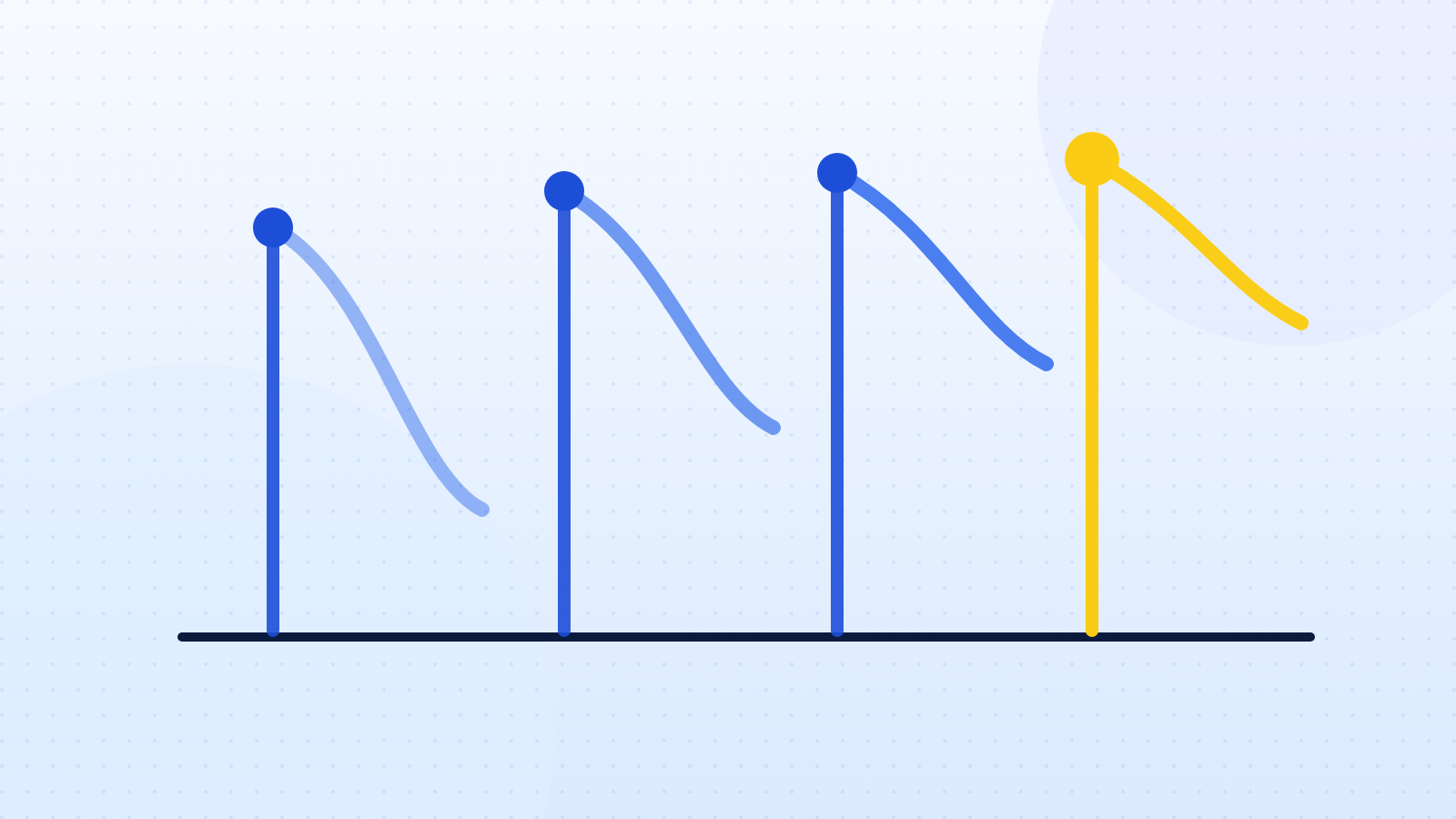
The same six hours, split across three weeks, will leave you knowing far more, because forgetting a little and then recovering it is what makes a memory durable. That is spaced practice, and it costs nothing except planning ahead.
In practice this means touching each subject more often for less time. Twenty minutes of recalling last week's topic at the start of a session is not a warm-up you can skip. It is the part doing the most work.
Planning this is a scheduling problem more than a study problem, and it is the reason a weekly plan matters more than a long evening. A subject you visit six times will beat a subject you sat with once, however long that once was.
Mix the subjects up
There is a strong temptation to finish one topic completely before starting the next. It feels orderly, and it quietly makes the work easier than it should be.
When you do twenty questions on the same topic in a row, you only have to work out how to solve it once. Question two through twenty use the method still sitting in your head from question one. You get faster, you feel fluent, and you have practised executing a method rather than choosing one.
The exam does not arrive sorted by topic. It gives you a question and expects you to know which approach it needs, which is the part you skipped.
So mix them. Do a few questions from this week's topic, a few from a fortnight ago, a few from last term. Your accuracy will drop and the session will feel worse, which is the same trade as retrieval practice: harder while you do it, considerably better a month later.
Mnemonics are for the parts that genuinely have no logic
Most material does not need a memory trick. It needs understanding, and reaching for a mnemonic first is a way of avoiding that.
But some things are simply arbitrary — an order of reactivity, a sequence of events, a list with no internal reason to it. For those, a rhyme, an acronym or a deliberately ridiculous mental image is a real tool, because there is nothing to understand and something to remember.
Make your own rather than borrowing one. The few seconds spent building it are themselves an act of retrieval, and a mnemonic you invented is far stickier than one from a textbook, usually because it is sillier.
Make your notes do something
Notes taken as a transcript of what a teacher said are a record of a lesson. They are not a study tool, and copying them out again later is re-reading with extra steps.
The Cornell system is the simplest fix: a narrow column down the left for questions, the wide part for the notes themselves, a few lines at the bottom for a summary in your own words. Write the questions after the lesson, not during it.
What that gives you is a set of notes you can immediately use for retrieval — cover the right-hand side, work down the questions, check. The format converts a transcript into a test, which is the only form of notes worth having.
Teach it to somebody
Explaining a topic out loud to another person is retrieval practice with nowhere to hide. You find out in about thirty seconds whether you understand something or have merely read it recently, because the sentence stops.
A study group is the natural place for this, provided it has rules: a topic agreed in advance, a start time, and somebody prepared to say the group has stopped working and gone to talking. Without those, a study group is a social event that costs you an evening.
If there is nobody available, explain it to a wall. It is less strange than it sounds and it works nearly as well — the difficulty was never the audience.
Study in the shape the exam is in
Learn the material in the form you will be asked for it. If the paper wants structured essays, practise structured essays. If it wants worked calculations under time pressure, do worked calculations under time pressure.
Students routinely revise for months in one format — reading, summarising, annotating — and then meet a completely different format on the day, and discover that knowing a topic and being able to answer a question about it in forty minutes are two separate skills. Only one of them was practised.
The same applies further out. The subjects you took at 16 shaped which of these formats you now face, and that choice decides more than most students realise at the time.
Fix the conditions, not just the method
None of the above survives a bad setup. Sleep is not the reward for finishing revision; it is when the day's learning is consolidated, and a night lost to cramming can cost more than the hours gained.
Work somewhere you can leave things out and be undisturbed. Put the phone in another room — not face down on the desk, which works perfectly if the goal is to think about your phone. If the power is unreliable where you are, keep an offline stack of past questions for the hours the screen is not an option, so a dark evening is still a working one.
Take real breaks, away from the desk and away from a screen. A break spent scrolling is not rest; it is a different kind of concentration, and you return from it with less than you left. Stand up, walk out, look at something further away than a page.
Eat before you study rather than studying through hunger and calling it discipline. And be honest about the hour you work best — some people genuinely think more clearly at five in the morning than at eleven at night, and the ones who do are usually the ones forcing themselves to revise late because that is what serious students are supposed to do.
Ten minutes that tell you whether any of this worked
At the end of each week, sit with a blank page and write down everything you can recall from one topic. No notes, no prompts.
What comes out easily is learned. What comes out in fragments needs another pass. What does not come out at all is the thing you would have discovered in the exam hall.
Then do the only step that matters: put the fragments and the blanks into next week's plan, before you look at anything new. Studying is not really about how many hours you put in. It is about whether you ever find out what you do not know while there is still time to do something about it.